How to test an AI model for fiction before you draft a book
Model leaderboards do not tell you whether a system can write your book. A useful fiction test gives two or three models the same difficult scene and scores the work you would otherwise have to repair.
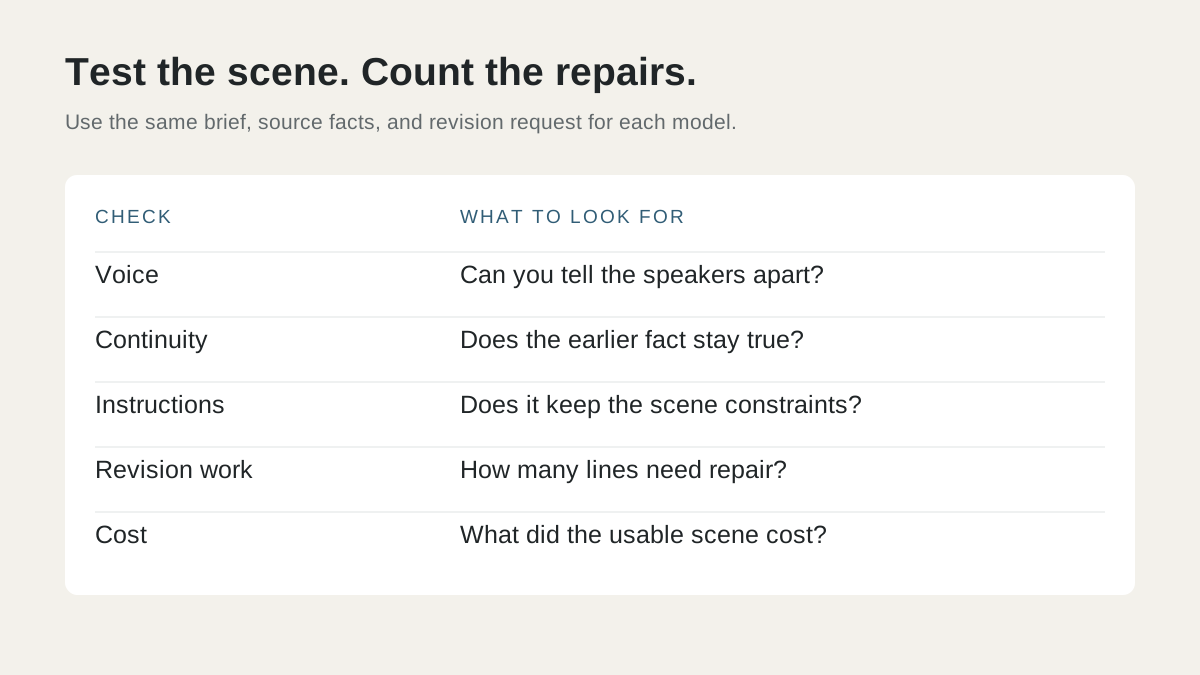
Use a repeatable scene test for voice, continuity, instruction following, revision load, and cost.
Choose a scene that exposes failure
Use a scene with two distinct voices, one important fact from an earlier chapter, a physical objective, and a tonal limit. Avoid an opening paragraph with no constraints. Almost any model can produce attractive atmosphere when it has nothing to remember.
Keep the input stable
Give each model the same outline, character facts, prior-scene summary, point of view, tense, and length range. Save the model name and settings. Run more than once because one lucky answer is not a reliable workflow.
Score the repair work
Mark factual errors, voice drift, repeated phrases, invented details, missed instructions, and lines you kept without change. Time one revision pass. Revision minutes are often a better measure than the quality of the first paragraph.
- Continuity accuracy
- Character voice
- Scene movement
- Instruction following
- Usable lines
- Revision time and model cost
Retest after workflow changes
A new prompt, larger context, story bible, or chapter-summary method can change the result as much as a model switch. Retest when you change one of these inputs and keep a small reference set so you can compare results over time.