
In this guide
AI fics usually break in the same places: the AI forgets canon after a few chapters, characters stop sounding like themselves, and the prose turns into one-line fragments. This guide fixes all three, using one example fic: a Sherlock Holmes story about Mrs Hudson and the empty rooms at 221B.
What Webnovels AI does for your fic
- Remembers your canon. Characters, places and rules live in Book memory, outside the chat, so chapter 20 still knows what chapter 1 said.
- Plans before it writes. Every chapter gets an outline you can fix in a minute.
- Checks every chapter for canon errors, out-of-character lines and AI habits, and asks before it changes anything.
- Draws your scenes from the same canon notes.
- Uses the AI you already have: a ChatGPT account, an API key or a local model.
1. Write a canon sheet
Write the canon your fic depends on, in your own words. List what canon never says, so the AI asks you instead of inventing it. Copy this and change the details to your fandom.
Canon sheet: The Empty Rooms

Fandom: Sherlock Holmes stories by Arthur Conan Doyle (public domain in the US).
Starts: 1892, while Holmes is believed dead, between "The Final Problem" and "The Empty House".
Divergence: none. This fic fills a gap in canon.

Canon characters:
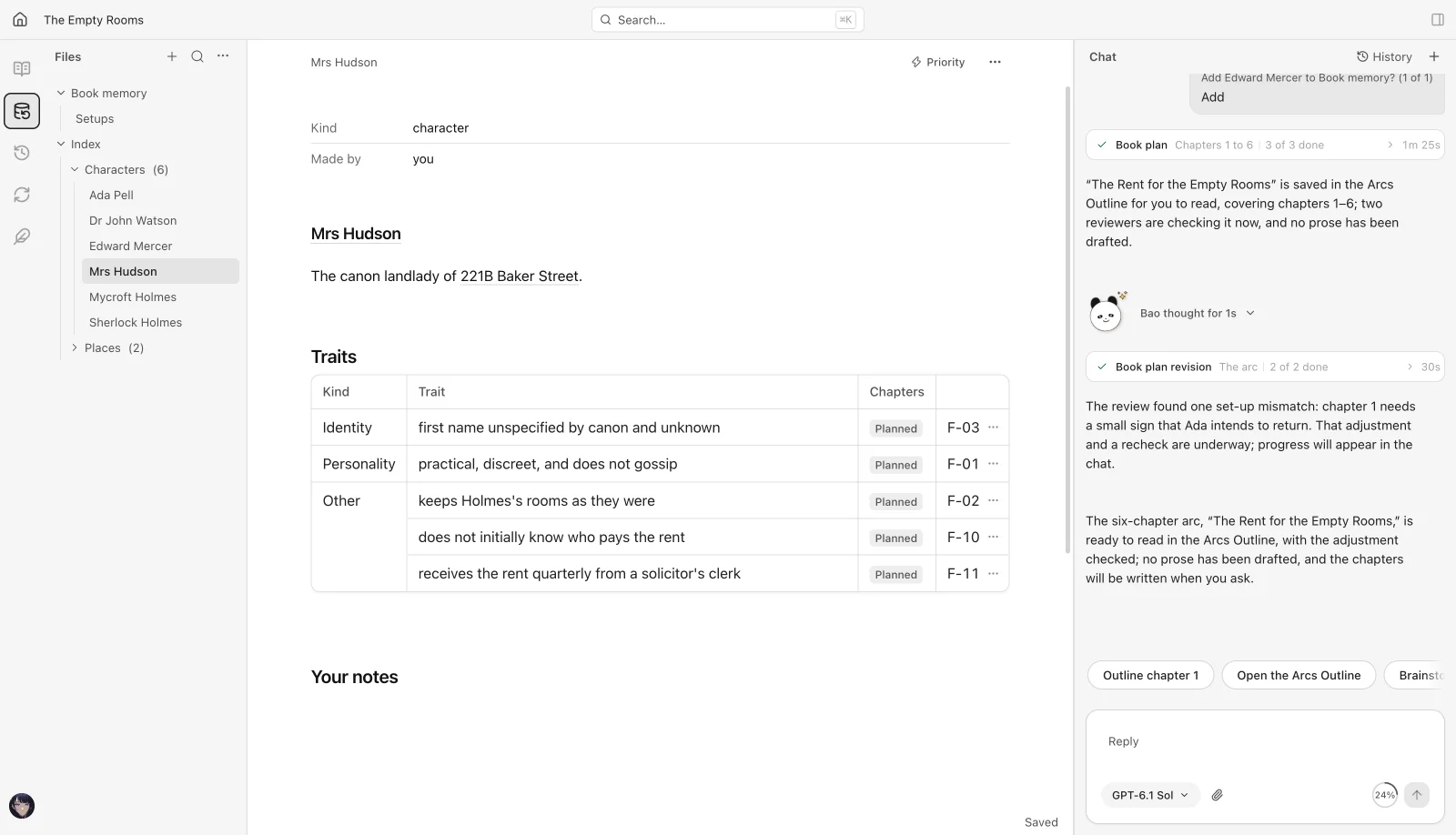
- Mrs Hudson: landlady of 221B Baker Street. Keeps Holmes's rooms as they were. Practical, discreet.
- Dr John Watson: believes Holmes died at the Reichenbach Falls.
- Mycroft Holmes: in "The Empty House", Holmes says Mycroft kept his rooms as they were.

My characters (OCs):
- Ada Pell: a typist who wants to rent the rooms. She must not solve anything Holmes solves in canon.

Canon never says: Mrs Hudson's first name, or who paid the rent. Do not invent these; ask me.
Rating: general audiences.
2. Start the fic
Choose New book, name your fic and open it. Skip the question card and paste this into the chat with your canon sheet:
This book is a fanfic. Treat my canon sheet as the source of truth. Save each character, place and rule to Book memory. Mark anything canon does not say as unknown, not as a fact. Ask me one question at a time about viewpoint, tense and length. Do not draft until I approve the direction.

[paste your canon sheet here]
3. Plan the chapter
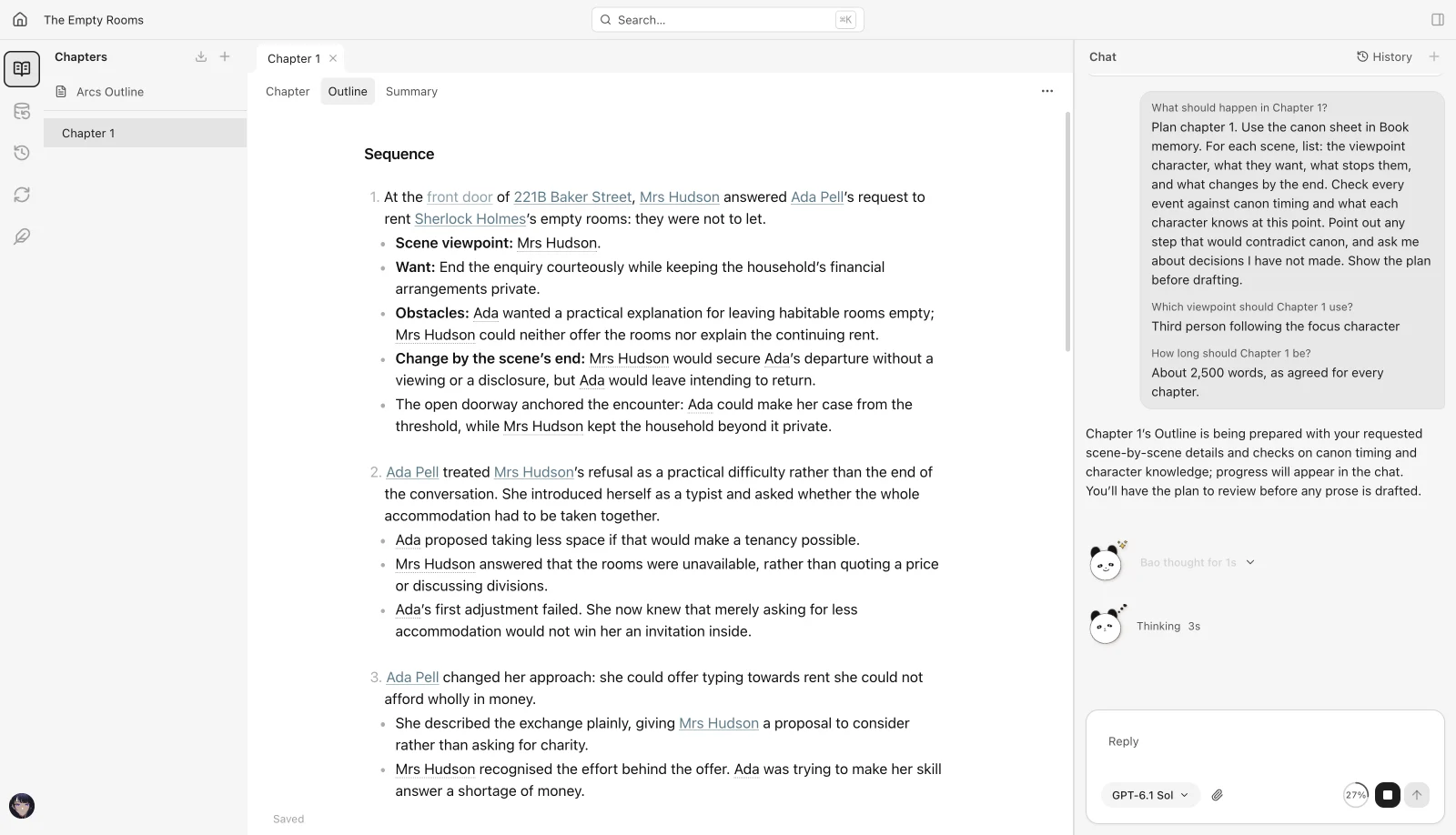
Type /outline-chapter and add your instructions. Answer the three questions (what happens, viewpoint, length), then choose Write the Outline.
/outline-chapter Plan chapter 1 from the canon sheet in Book memory. For each scene, list the viewpoint character, what they want, what stops them, and what changes. Point out anything that would contradict canon.
4. Write the chapter
Type /write to draft from the plan.
/write Write chapter 1 from its outline. Keep each canon character's way of speaking as described in Book memory. Do not add facts that are not in the outline or the canon sheet.
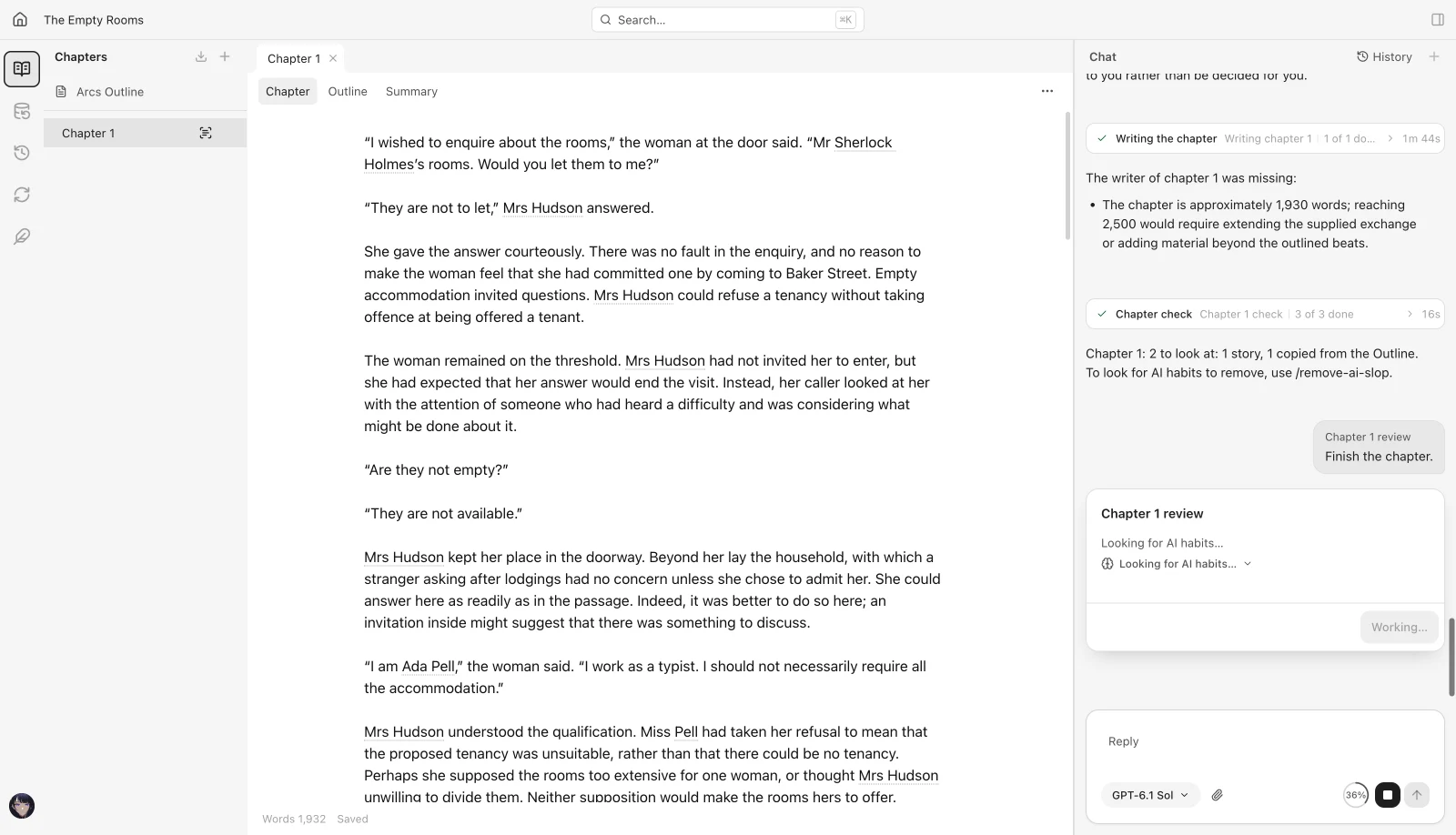
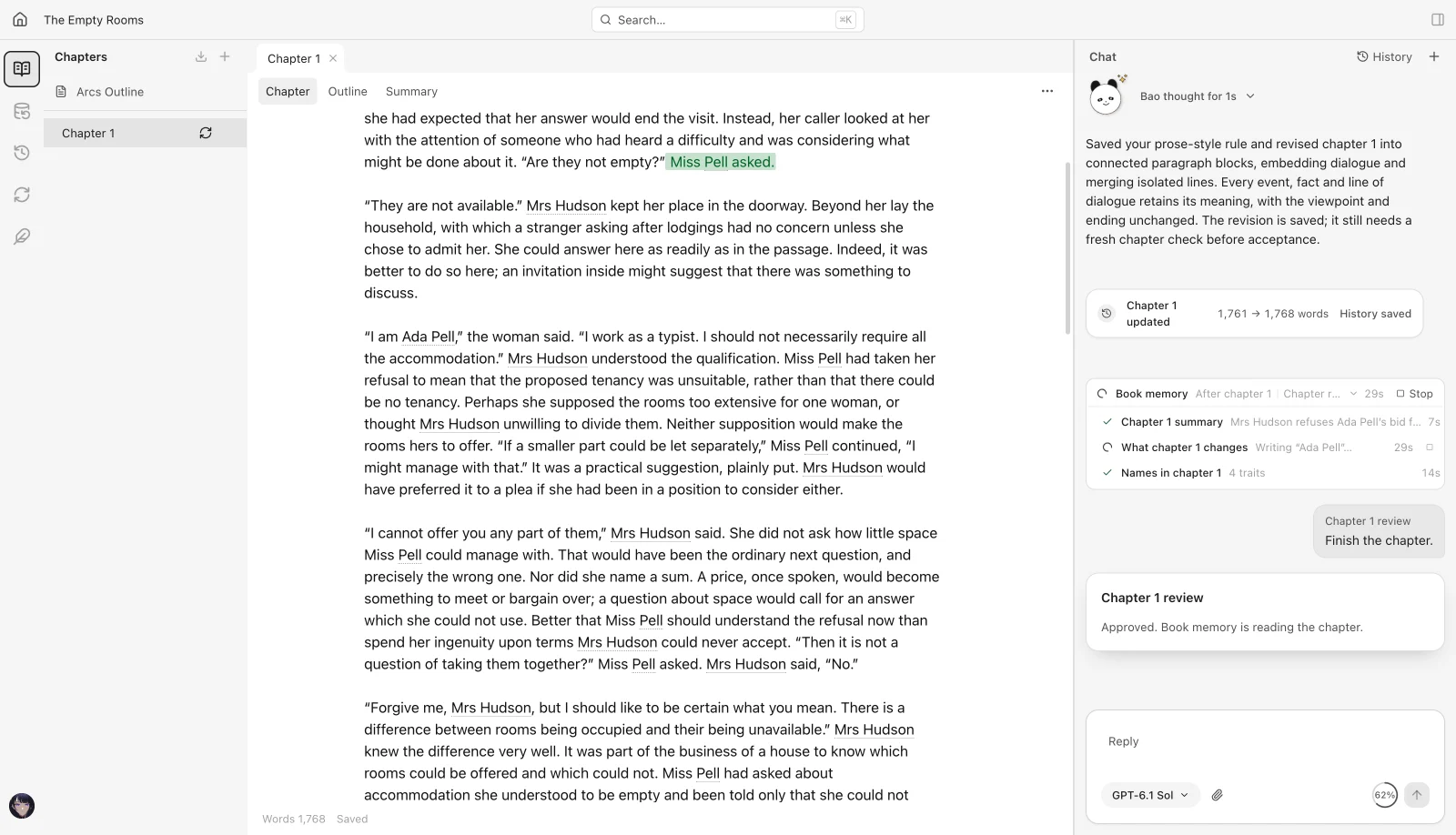
The first draft has the usual AI rhythm: one line, one paragraph. Fix it once for the whole fic with a style rule. Bao saves it to Book memory and follows it in every chapter after this one.
Save this as a book rule for prose style, then revise chapter 1 to follow it.

Do not write isolated one-line sentences, orphaned reaction beats, or chopped dramatic fragments. Do not put every sentence on its own line. Write in flowing book-style paragraph blocks where each paragraph contains several connected sentences, usually 8-12 sentences. Dialogue should be embedded into the same paragraph as the surrounding action, reaction, body language, and sensory detail unless a new speaker or major beat truly requires a new paragraph. Before sending, merge any one-sentence paragraphs into the paragraph before or after them. Standalone single-sentence lines are allowed only for rare major dramatic impact, no more than once in a long reply. Before replying, scan the entire response. If there are multiple short one-line paragraphs, fix them. Combine them into dense narrative blocks. Do not use line breaks for emphasis. Do not stack sentences vertically. No cinematic subtitle formatting. No poetic chopping. The response should look like a novel page, not a screenplay, poem, or mobile chat transcript.
5. Check canon and AI habits
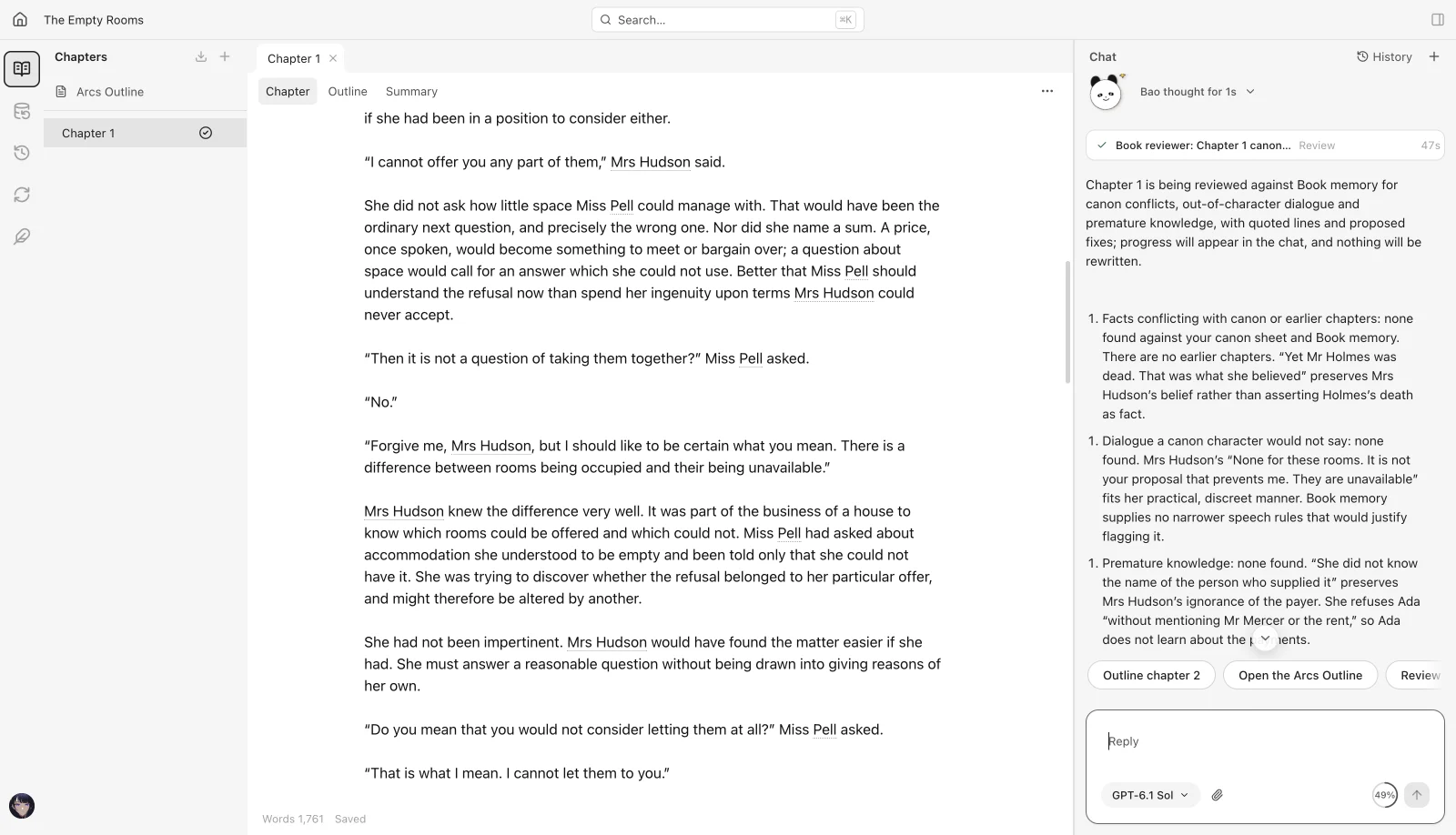
Type /review to check the chapter against your canon. Nothing changes until you choose Make this change or Keep changes.
/review Review chapter 1 against Book memory. List facts that conflict with canon, dialogue a canon character would not say, and things a character knows too early. Quote each line. Propose fixes for my approval. Do not rewrite the chapter.
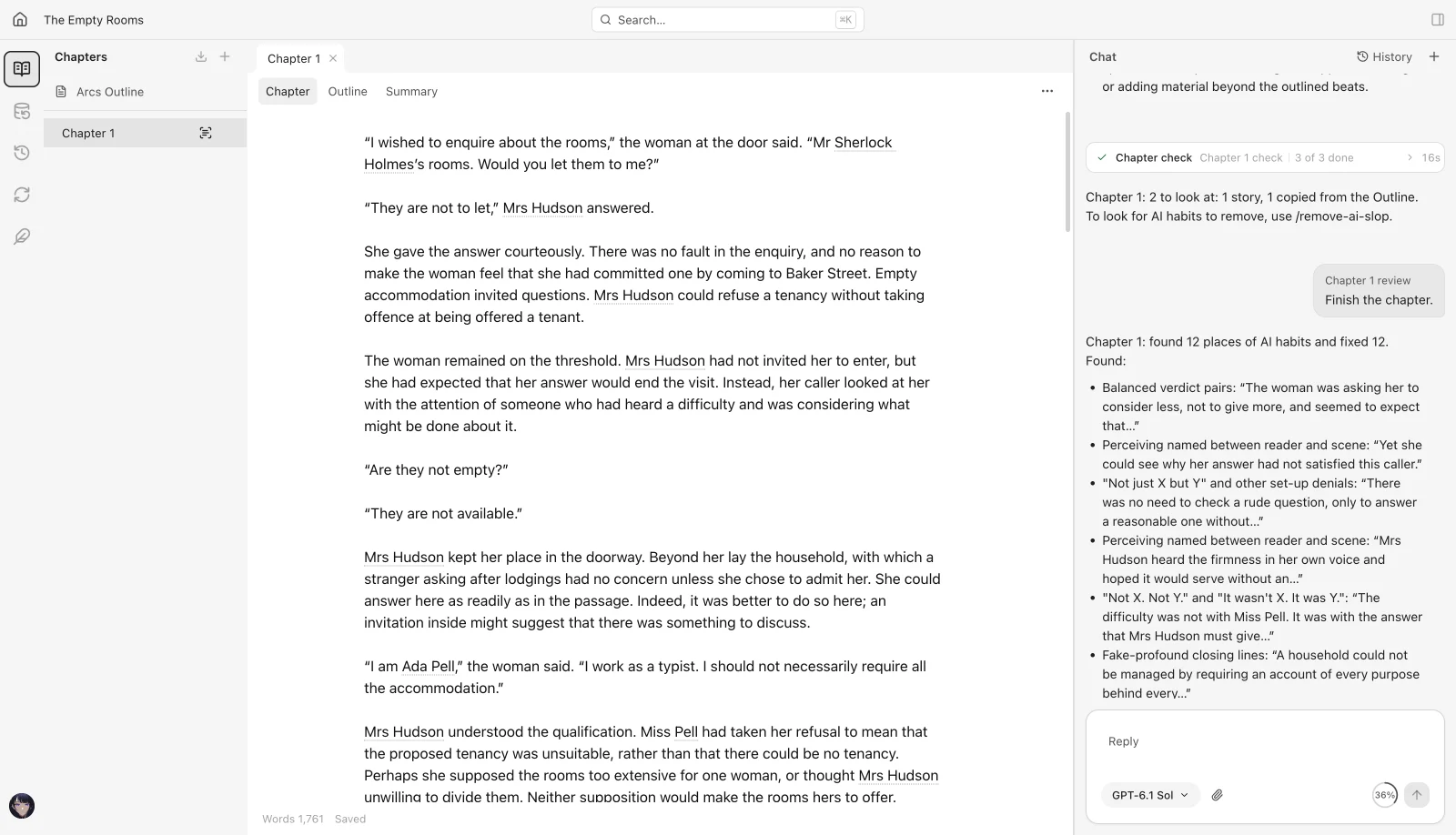
Then type /remove-ai-slop to find stock AI phrasing. Each habit is named and quoted, so you decide.
6. Add scene art
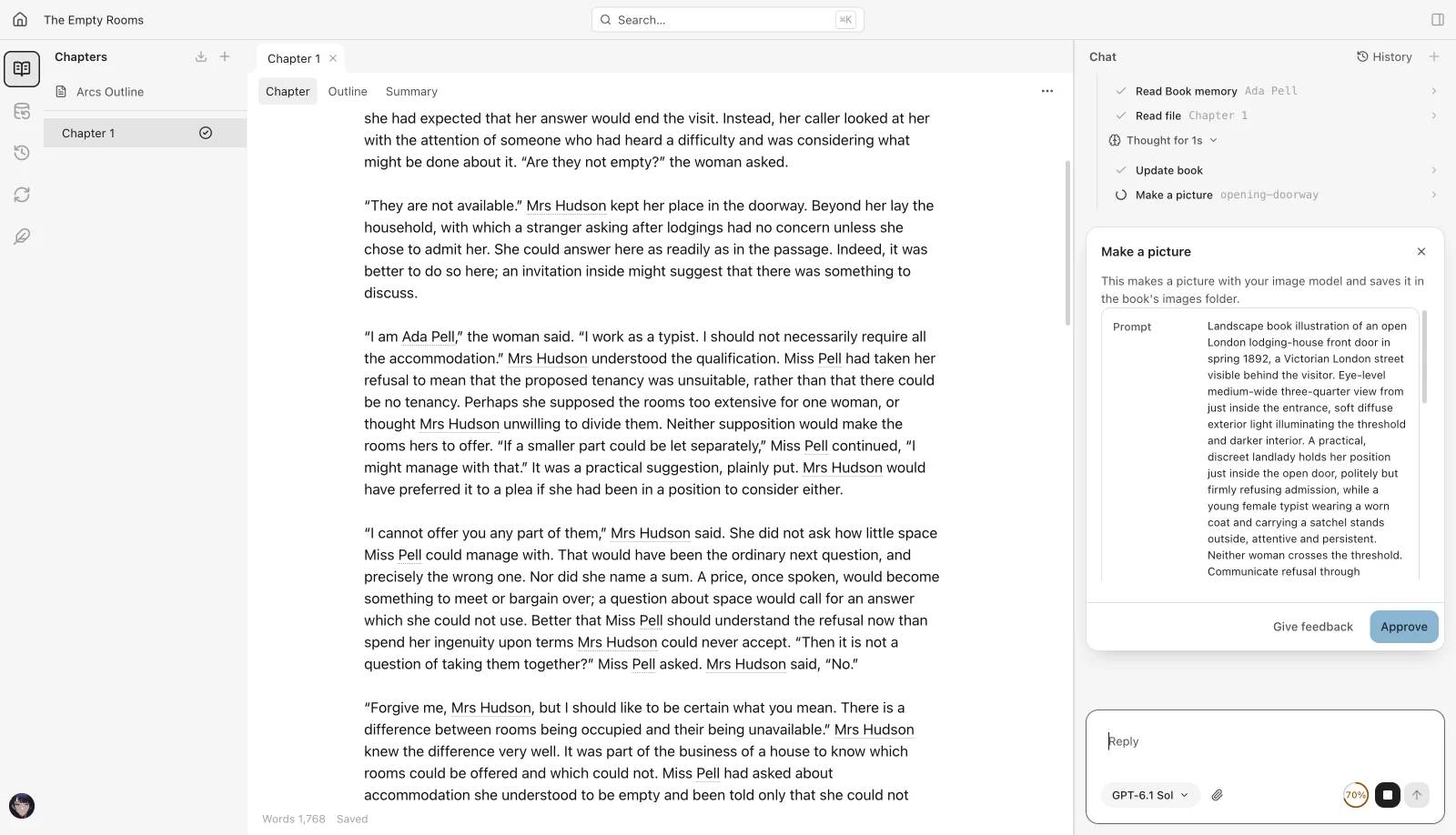
Type /image and describe the scene. The app reads the characters and places from Book memory, so the picture matches your fic. Images need an image model in Settings › Model Config.
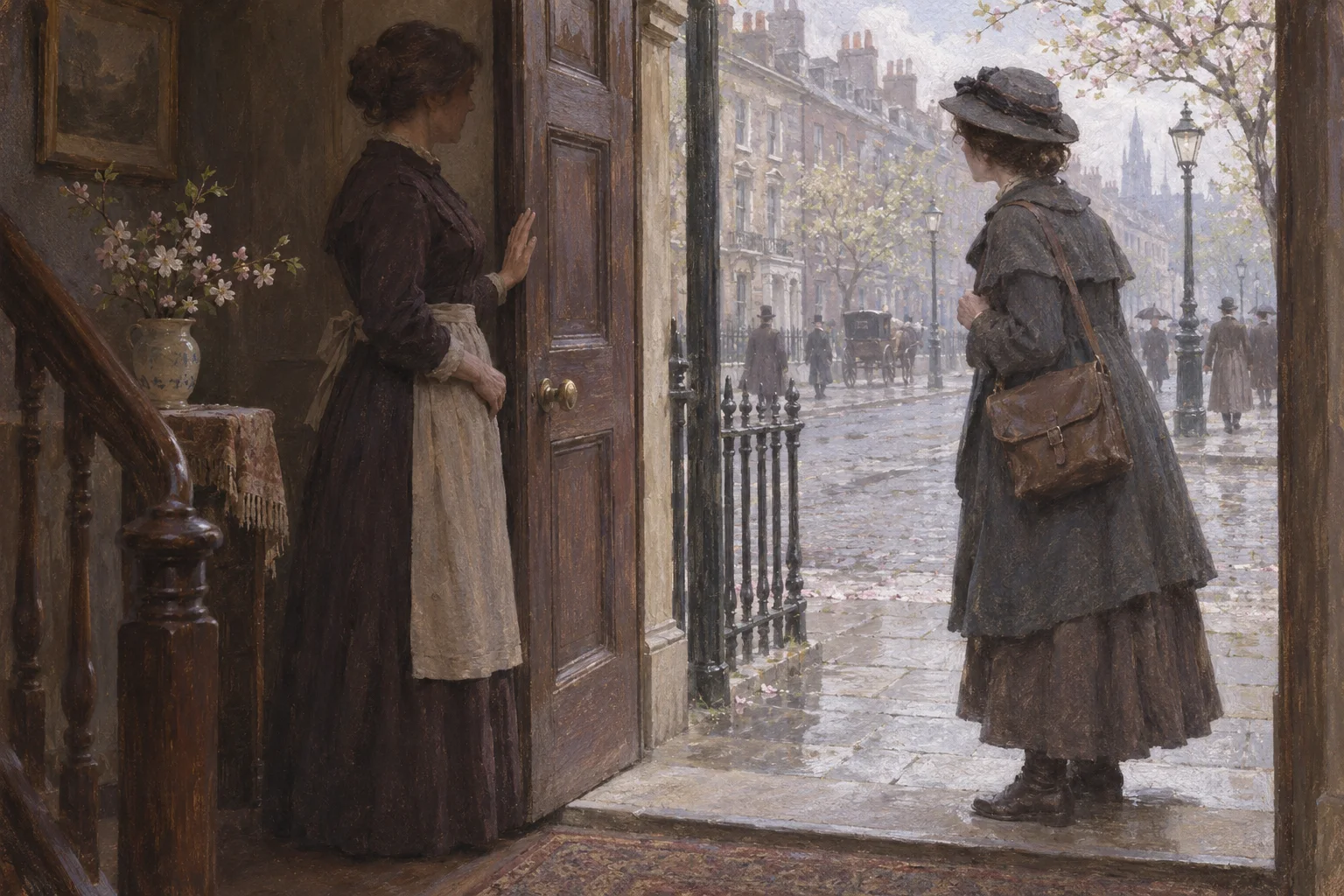
/image Draw the opening scene of chapter 1: Mrs Hudson at the open front door of 221B Baker Street in spring 1892, refusing Ada Pell, a young typist with a worn coat and a satchel. Victorian London street behind them. Use the descriptions in Book memory. Painterly book-illustration style, landscape. No text in the image.
The result
The opening of the finished chapter 1, with its scene art:
“I wished to enquire about the rooms,” the woman at the door said. “Mr Sherlock Holmes’s rooms. Would you let them to me?”
“They are not to let,” Mrs Hudson answered. She gave the answer courteously. There was no fault in the enquiry, and no reason to make the woman feel that she had committed one by coming to Baker Street. Empty accommodation invited questions. Mrs Hudson could refuse a tenancy without taking offence at being offered a tenant. The woman remained on the threshold. Mrs Hudson had not invited her to enter, but she had expected that her answer would end the visit. Instead, her caller looked at her with the attention of someone who had heard a difficulty and was considering what might be done about it. “Are they not empty?” the woman asked.
“They are not available.” Mrs Hudson kept her place in the doorway. Beyond her lay the household, with which a stranger asking after lodgings had no concern unless she chose to admit her. She could answer here as readily as in the passage. Indeed, it was better to do so here; an invitation inside might suggest that there was something to discuss.
“I am Ada Pell,” the woman said. “I work as a typist. I should not necessarily require all the accommodation.” Mrs Hudson understood the qualification. Miss Pell had taken her refusal to mean that the proposed tenancy was unsuitable, rather than that there could be no tenancy. Perhaps she supposed the rooms too extensive for one woman, or thought Mrs Hudson unwilling to divide them. Neither supposition would make the rooms hers to offer. “If a smaller part could be let separately,” Miss Pell continued, “I might manage with that.” It was a practical suggestion, plainly put. Mrs Hudson would have preferred it to a plea if she had been in a position to consider either.
Post it
Read the AI rules of the archive where you post, and add a short author’s note:
Author's note: I planned this fic and wrote the canon sheet and outline myself. I used Webnovels AI to draft chapters from my outline and to check canon. I edited every chapter before posting.
For more on cleaning up AI prose, see the guide to removing AI slop.
FAQ
What is the best AI for writing fanfiction?
Any strong chat model can draft a fic. What breaks a long fic is memory: a chat forgets early chapters and starts to contradict canon. Use a tool that keeps your canon outside the chat, and test the model on your fandom before you trust it.
Why does my AI fanfic fall apart after a few chapters?
Old chapters drop out of the chat’s memory first. Keep your canon in a written sheet, plan each chapter before it is written, and check each chapter against the sheet.
Do I have to say that I used AI?
Read the current rules of the archive where you post, because they differ and change. Either way, a one-line author’s note that says how you used AI is the honest choice.