How to fix a sagging middle without adding filler
A middle usually feels slow because events stop changing the available choices. More action does not solve that problem if the characters finish each scene in the same position.
Diagnose lost pressure in the middle of a novel and rebuild cause, choice, cost, and change.
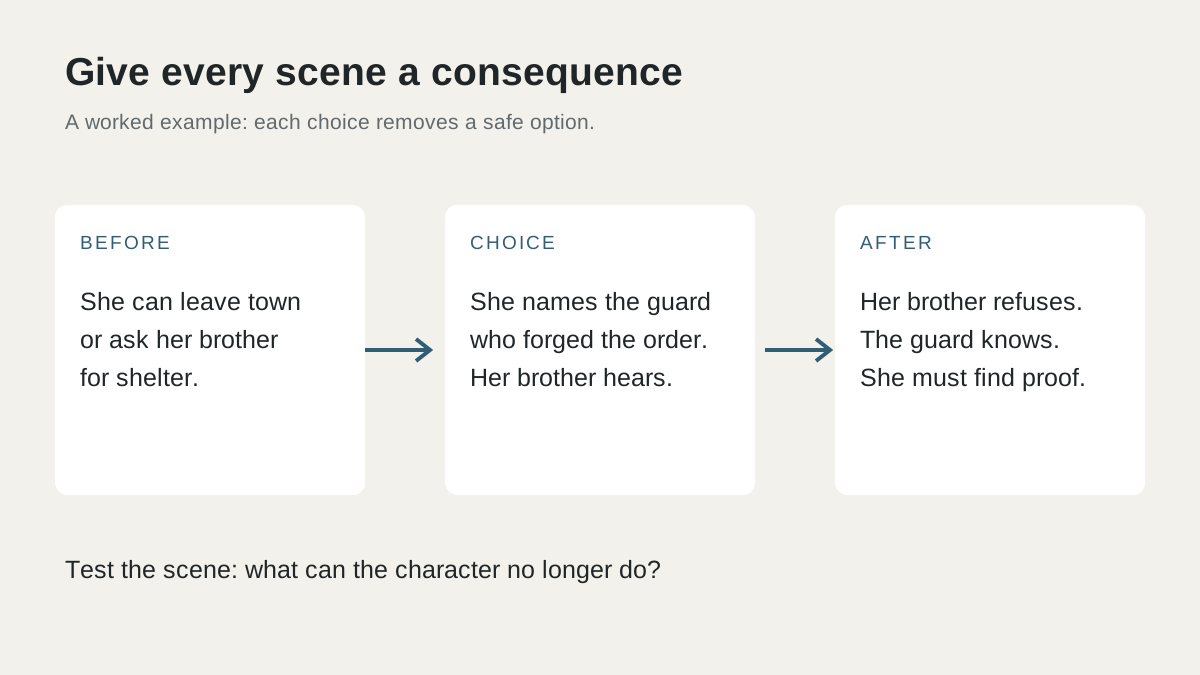
Write the before-and-after test
For each middle scene, write one sentence for what the viewpoint character can do before it and one for what they can do after it. If nothing important changes, the scene may be repeating information or postponing a decision.
Change can be knowledge, bargaining power, danger, trust, location, time, or commitment. It does not have to be a fight.
Reconnect scenes with consequences
The next scene should exist partly because of the prior one. Replace “and then” links with “therefore” or “but” links. A victory can reveal a larger cost. A failed plan can force a choice the character wanted to avoid.
Make the midpoint close a door
A useful midpoint changes the story’s operating conditions. The protagonist learns the real problem, loses a safe option, commits publicly, or causes damage that cannot be ignored. The second half should not be able to return to the opening plan.
Cut repeated proof
Once the reader believes a relationship is tense, a journey is dangerous, or a system is corrupt, the next scene must develop that fact. Combine scenes that perform the same emotional or plot function and preserve the strongest details from each.