Best AI translator for novels: how to test
There is no useful winner from one sample sentence. A novel translator must keep decisions across chapters, recover from a failed job, show enough source context for review, and export a book that you can correct. Test the complete workflow with your language pair and genre.

No AI translator wins on one sample sentence. Run the same hard chapter through each and compare names, glossary control, resume, export, privacy and cost.
Build one fair test chapter
Choose a chapter with at least three speakers, omitted pronouns or ambiguous identity, recurring names, a genre term, numbers, dialogue, and a reference to an earlier event. Keep one clean source file and one glossary for every tool.
Do not change the prompt after seeing each result. Run the same task, save the output, and compare it with the source. If the tool has a dedicated glossary feature, use it and record how much setup it required.
Score errors by what they change
Mark omissions, additions, wrong identity, wrong negation, number changes, terminology drift, broken formatting, and unnatural English. Give story-changing errors more weight than punctuation and style preferences.
Read the chapter without the source after the accuracy check. Note where the English becomes confusing, repetitive, or unlike the character. A tool can be accurate but tiring to read, or fluent but wrong.
Test the project features
Import several chapters, stop a job, and resume it. Change one glossary term and see whether the interface identifies affected chapters. Check whether you can view source and translation together, retry one chapter, export separate files, and keep chapter order.
A general chat tool can translate a passage well but leave you to manage files, glossary versions, retries, and exports. A novel product should reduce that project work without hiding the source.
- Glossary and name control
- Saved chapter context
- Retry and resume behaviour
- Source-to-translation review
- EPUB or structured export
- Usage limits and cost controls
Check privacy, rights, and current pricing
Read where the service processes text, how long it retains files, whether customer text trains models, and how to delete a project. Confirm that you are allowed to upload the source. Do not use a tool’s technical ability as proof that the upload is lawful.
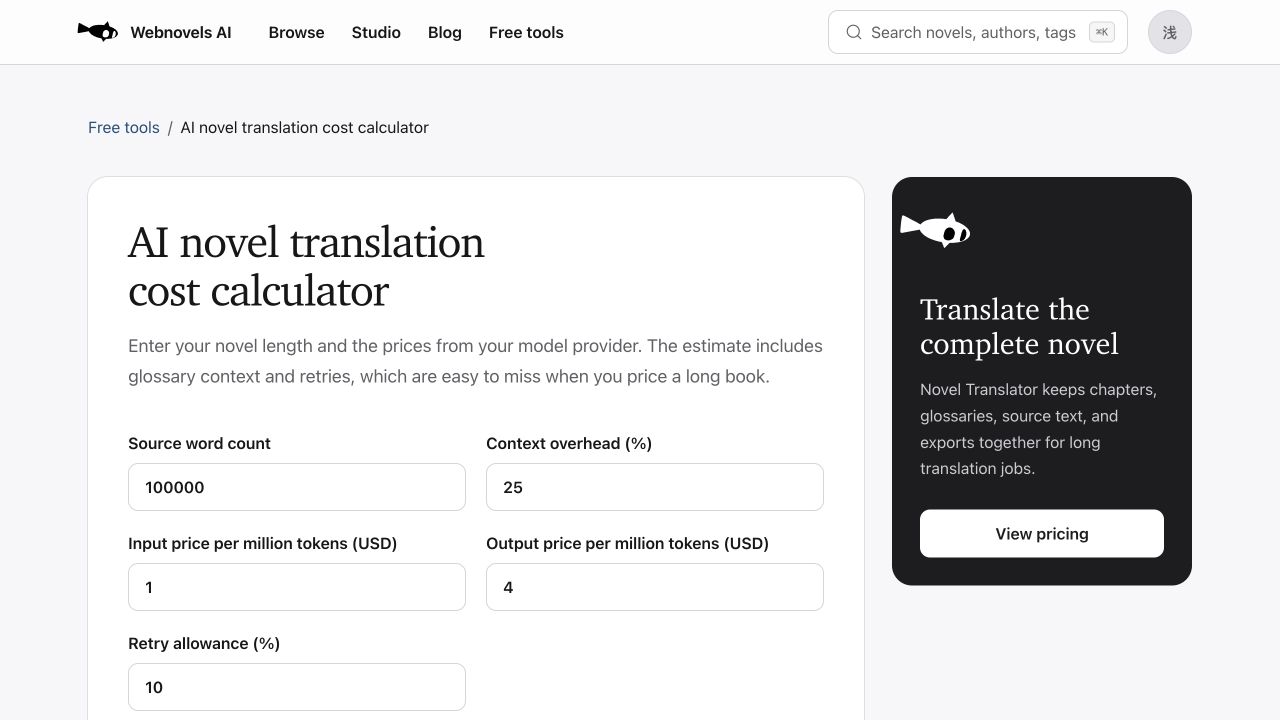
Calculate cost from a measured chapter and include repeated context, retries, and review time. Check official pricing on the day you decide because model rates and product limits change.
Choose for your purpose
For a private reading copy, prioritise understandable output, glossary control, cost, and easy correction. For professional work, add client privacy requirements, audit records, source-language review, editing, and rights clearance.
Keep your test results. A later model or product update can be run against the same chapter, which gives you a useful comparison instead of a new marketing claim.